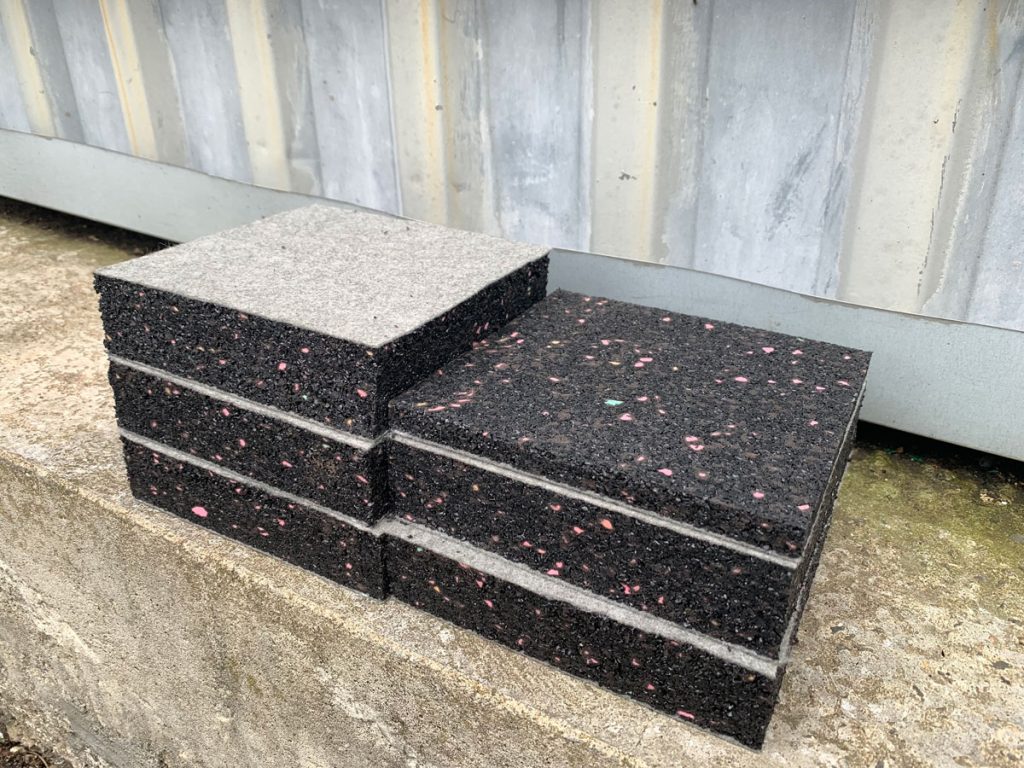
Under ballast mats are a multi-layer construction consisting of a vibration-damping material (natural and synthetic rubbers, homogeneous or composite polyurethane-based materials, foamed or homogeneous polyurethanes) with additional reinforcing layers of non-woven fabric or high-strength geotextile.
The mats are installed between the ballast layer and the main platform of the subgrade (or a rigid base — bridges, tunnels, overpasses, concrete slabs) for vibration isolation, reduction of secondary and re-radiated noise, as well as to reduce dynamic loads on the track structure and ensure track stability.
The correct choice of mat stiffness depends on the intended application, the track superstructure design and operating conditions. Depending on the type of mat, the thickness of the elastic layer is selected so that the required static and dynamic stiffness is achieved overall.
Under ballast mats limit static and dynamic forces and evenly distribute the load from rolling stock onto the subgrade, which contributes to improved track stability and, consequently, allows maintenance and repair costs to be reduced. Under ballast mats can be used for constructing sections of variable stiffness, including in the transition zone adjacent to an engineered structure, between different track superstructure designs (e.g. standard and vibration-protective).
In some cases, the use of under ballast mats also makes it possible to reduce the thickness of the ballast layer, which lowers costs and increases the speed of construction and repair.