Areas of application
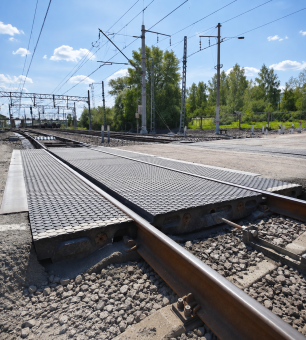
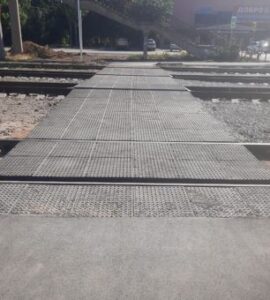
The A1.USIN GE2K coating system is designed for filling technological joints in road pavements, sealing fixing heads, and filling cavities between rubber technical products and metal elements, and road pavement, including:
-
Monolithic embedding of metal embedded parts;
-
Installation of transition zones of span structures;
-
Sealing of fixing heads made of rubber slabs.
Advantages
-
High curing speed and short maturation time before operation (wheel load is allowed after 12 hours);
-
Excellent resistance to abrasive wear under wheeled traffic;
-
High adhesion to metal bases, concrete surfaces, and waterproofing coatings of the span structure;
-
High elasticity and resistance to impact loads;
-
Solvent-free and has no volume shrinkage;
-
The system forms a non-slip coating;
-
Wide operating temperature range from -50 to +90 (short-term +130) ℃;
-
Resistance to rutting;
-
Resistant to salt solutions (including de-icing agents), alkalis, and acids.
Application technology
Working conditions
-
Minimum ambient and base temperature +5 ℃;
-
Maximum ambient and base temperature +35 ℃.
-
When applying the material, the temperature must always be 3°C above the dew point. The conditions must be observed during the work and until the materials are fully cured.
-
The temperature of the A1.USIN GE2K components before use must be at least +10°C and not more than +30 ℃; it is recommended to keep the components before use at a temperature of +15…+23 ℃ for 12 hours.
-
The conditions must be observed during the work and until the materials are fully cured.
-
Quartz sand of 0.1–0.3 mm fraction may be added to the A1.USIN GE2K product.
-
Mixing proportions of the polymer part A+B+C (accelerator is added at 1-2% depending on temperature conditions) with filler C = 1.0: 1.0 by weight (1 kg of A+B to 1 kg of C).
-
The filler must be dry, without foreign inclusions and oil contamination.
-
It is not allowed to use filler whose packaging has traces of moisture or oil contamination.
Surface preparation
Concrete
The base must be strong (concrete class not less than B20), cleaned of dust, dirt, petroleum products, oil, cement laitance, paint, and other materials. The base should be prepared by shot blasting or milling to remove cement laitance and obtain an open, rough surface. Areas of weak concrete must be removed: surface defects such as voids and cavities must be opened up. Wet areas must be dried. The prepared base must be treated with A1.USIN PU90 primer using a brush/roller, with a consumption of 0.2 kg/m². It should be remembered that mechanical preparation of the base is used not only to remove contaminants but also to increase the adhesion of the coating to the base. The more textured the surface obtained as a result of treatment, the higher the adhesion of the coating to the base and, consequently, the higher the resistance to dynamic loads.
Metal
Degrease the metal surface to the first degree according to GOST 9.402. Clean from scale, rust, and old paint by abrasive blasting or mechanical means to a degree not lower than 2 according to GOST 9.402 (Sa 2 ½ according to GOST R ISO 8501-1-2014). Preparation to Sa 2 degree is allowed depending on the conditions of further operation. Recommended surface roughness is 20–40 μm according to ISO 8503–2. Manual cleaning to a degree not lower than 2 according to GOST 9.402 is allowed (to a degree not lower than St 2 according to GOST R ISO 8501-1-2014). Preparation of working compounds. Mix components A and B (the accelerator is added if it is necessary to accelerate the polymerization process at low temperatures) of A1.USIN GE2K in a clean, dry container with a volume of at least 20 liters. Mixing should be done using a pneumatic/electric mixer (as well as a spiral whisk for dry building mixes) at 400–600 rpm for 1.5–2 minutes (add if necessary), then add component B and mix for 1.5–2 minutes, paying special attention to the walls and bottom of the container. Perform the stepwise addition of the mineral filler (component C of the A1.USIN GE2K composition) into the container with the mixed polymer composition A1.USIN GE2K (in parts of approximately ¼) and mix the mixture with the filler thoroughly, preventing clumping. At the same time, it is necessary to secure the mixing container to prevent rotation of the container itself. Mixing should be done for at least 2 minutes and not more than 5 minutes. For 1 kg of the A+B+C mixture (accelerator is added depending on temperature conditions), it is allowed to add 1 kg of filler C of 0.1–0.3 mm fraction.
Installation technology and material consumption
Unload the resulting mixture into the joint area or cavity requiring sealing and filling. The installation of the A1.USIN GE2K system is allowed only on a dry base, cleaned of oil contamination and efflorescence. When installing the polymer composite system, it is allowed to use hand tools such as a trowel, flat spatula, and flat screed, which can be used as auxiliary tools for unloading the compound with minimal losses, as well as for distributing in the installation area and leveling.
The table provides examples of installation technology and material consumption. The given consumption rates do not take into account material losses associated with the nature, porosity, surface profile, etc., and may differ slightly in specific cases.
Tool cleaning
Clean the tool with a solvent (before the material cures). It is allowed to use solvent or xylene for cleaning the tool. Cured material is removed mechanically.
Tolerances for the finished coating
When inspecting the appearance, the absence of through pores, cracks, bubbles, delamination, cavities, and sagging is checked. Non-through pores, sagging, and smoothed tool marks are allowed, the size of which when measured (height, width, depth, diameter, etc.) is not more than 0.5 mm. The color of material batches may differ.
Precautions
During work with the material, it is not recommended to use open fire or perform welding works – to avoid overheating of the components and ultra-fast curing of the mixture. The material polymerizes quickly after mixing the components; do not allow stoppages in work to fully use the kit. The material may cause skin irritation. It is recommended to use protective equipment. If the material gets on mucous membranes or in the eyes, immediately rinse them with plenty of water and consult a doctor.